Clamps and Supports
Clamps and supports can be manufactured in Plastic and metal.
The older style plastic clamps, (green or blue) have a bore with voids in, these voids can retain water in them which has a knock on effect of causing pipe corrosion.
The newer plastic clamps (black) are thought of as a more non-corrosive clamping system as they have a smooth bore.
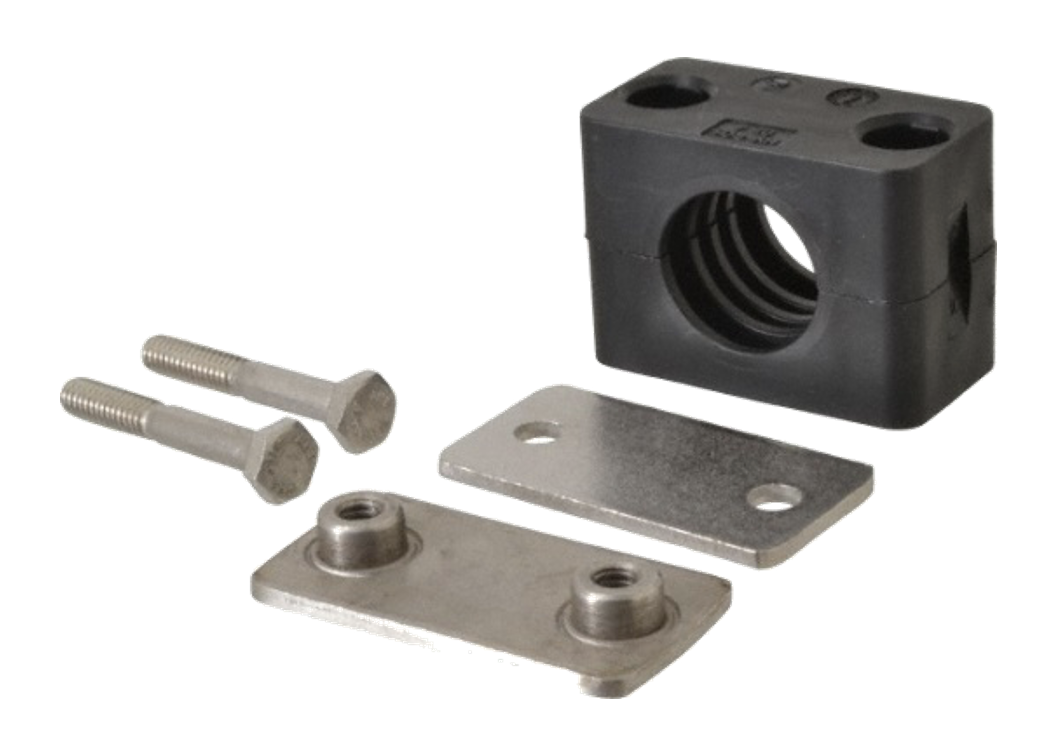
The metal clamps are not recommended, as they can damage the tube by either biting into the tube when tightened, or wear down wall thickness by rubbing the tube walls when subjected to vibration.
- Tube clamping is sued to help support SBT systems as well as protect against possible vibration, pre-stressing and strain.
- If the clamping is done correctly, it has a positive effect on a systems integrity and radically reduces the chance of failure in service.
- If the clamping is done incorrectly then this can have a negative effect, weakening a system and increasing risks of failure in service.
- Clamps on a SBT system must be spaced out correctly.
- Any components such as valves or regulators etc. in the line must be adequately supported.
- Tubing must not be thought of as a support in itself and must never be used as a platform or ladder.
- When clamping tubing, consider galvanic corrosion and don’t let the run contact dissimilar metals.
- Use clamping as a means of reducing vibration in the system.
- A tip when clamping to reduce stress on a run, would be to clamp before and after bends, connections and instruments.
- When dealing with SBT systems with possible temperature fluctuations remember to use expansion loops.
When routing a SBT run avoid potential vibration from equipment. Never clamp onto vibrating equipment pumps, compressors etc.
A good guide line for clamp spacing is as follows:
| OD | Distance |
|---|---|
| 6 – 10mm | 600mm |
| 12 – 22mm | 900mm |
| 25 – 32mm | 1400mm |
3 or more runs should be supported in a cable tray or similar. Always route SBT runs away from/avoiding equipment or apparatus that requires regular checks or maintenance.
Where possible tube and components should be kept from contacting any zinc coated and/or galvanised components, contact with such materials can lead to corrosion.